

Introduction
Artificial Intelligence (AI) is rapidly transforming industries across the world, from healthcare and finance to manufacturing, education, and public administration. One of the most significant sectors now beginning to experience this transformation is the legal and judicial system. For centuries, the administration of justice has depended primarily on human reasoning, interpretation of laws, and the wisdom of judges. While these human elements remain central to the justice system, modern legal systems increasingly face challenges that require technological support.
The growing complexity of legal frameworks, the enormous volume of litigation, and the vast amounts of legal documentation involved in modern judicial processes have made it increasingly difficult for courts to function efficiently using traditional methods alone. Artificial Intelligence offers a powerful set of tools that can help legal professionals process information faster, analyze large datasets, and support judicial decision-making. If implemented responsibly, AI can significantly improve the efficiency, transparency, and accessibility of justice delivery systems around the world.
Why the Legal System Needs Artificial Intelligence
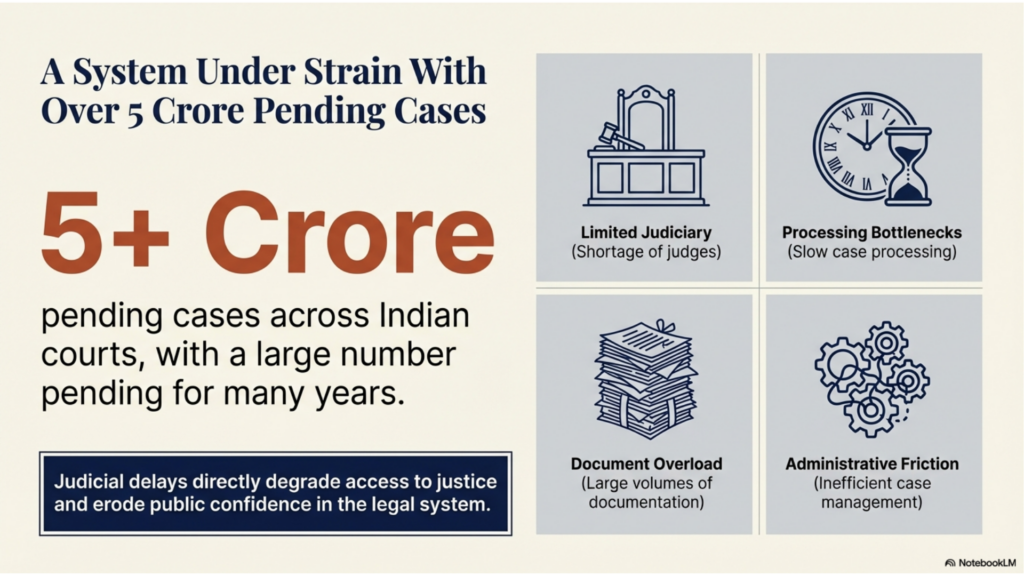
The legal system operates on information. Every legal decision requires the careful analysis of statutes, precedents, arguments presented by lawyers, and evidence submitted in court. As societies grow more complex, the volume of legal information that must be examined in each case continues to increase. This has placed tremendous pressure on courts and legal institutions.
The situation is particularly serious in countries like India. According to publicly available data, more than five crore cases are currently pending across different levels of the Indian judiciary. Many cases remain unresolved for years, and sometimes even decades. Such delays weaken public confidence in the justice system and undermine the fundamental legal principle that justice must be delivered in a timely manner.
A number of factors contribute to these delays. Courts must deal with large volumes of legal documents, lengthy case records, and complex procedural requirements. Legal research often takes considerable time, and manual case management systems can slow down administrative processes. Artificial Intelligence offers the possibility of addressing many of these challenges by assisting judges, lawyers, and court administrators in processing large volumes of information more efficiently.
It is important to emphasize that AI is not intended to replace human judges or legal professionals. Rather, it serves as a decision-support technology that enhances the ability of legal experts to analyze information, identify patterns, and make informed judgments.
Current Applications of AI in Law
Artificial Intelligence is already being used in several areas of legal practice around the world. These technologies help improve productivity, reduce operational costs, and enhance the quality of legal services provided by law firms, corporate legal departments, and courts.
AI-Powered Legal Research
Legal research is one of the most time-consuming aspects of legal practice. Lawyers and judges must often review thousands of judicial decisions and statutory provisions to identify relevant precedents for a particular case. AI-powered legal research tools use Natural Language Processing (NLP) to analyze vast legal databases and identify relevant case laws in a matter of seconds.
These systems are capable of understanding the context of legal queries and retrieving judgments that contain similar legal principles. They can also summarize complex legal decisions and highlight key legal arguments, thereby saving significant time for legal professionals. Globally, platforms such as Westlaw Edge, LexisNexis, and CaseText have integrated AI technologies to enhance legal research capabilities. In India, legal research platforms such as Manupatra, SCC Online, and Indian Kanoon are also incorporating intelligent search technologies to assist legal practitioners.

Document Automation
Legal practice involves drafting a large number of documents, including contracts, agreements, petitions, affidavits, and legal notices. Traditionally, lawyers spend considerable time preparing such documents manually. AI-powered document automation systems can generate legal documents automatically based on predefined templates and relevant legal information.
These systems help ensure that documents follow standardized formats and contain all necessary legal clauses. By reducing repetitive drafting work, document automation allows lawyers to focus more on strategic legal analysis and client counseling.
Contract Analysis
Large corporations often manage thousands of contracts that govern commercial relationships with suppliers, customers, and partners. Reviewing these contracts manually can be extremely time-consuming and prone to human error. AI-based contract analysis tools can quickly examine large volumes of contracts and identify important clauses, potential risks, and deviations from standard legal provisions.
Such technologies are widely used in corporate legal practice, particularly during mergers and acquisitions, regulatory compliance reviews, and due diligence exercises.
Predictive Legal Analytics
Another emerging application of AI in law involves predictive legal analytics. By analyzing historical case data, AI systems can identify patterns in judicial decisions and provide insights into litigation trends. These tools can help lawyers assess potential legal risks and develop more effective litigation strategies.
Although AI cannot determine the outcome of a case with certainty, predictive analytics can provide useful insights based on past judicial decisions and legal precedents.
AI-Based Case Management
AI can also play an important role in improving court administration. Intelligent case management systems can help courts organize and monitor large numbers of cases more efficiently. These systems can automatically categorize cases, prioritize urgent matters, schedule hearings, and track case progress.
Such technologies can significantly improve the efficiency of court administration and reduce delays in case processing.
Artificial Intelligence in the Indian Judiciary

India has already taken several steps toward integrating technology into the judicial system. One of the most significant initiatives is the e-Courts Mission Mode Project, which aims to digitize court processes across the country and improve access to judicial services.
The Supreme Court of India has also experimented with AI-based tools to assist judges and court staff. One such initiative is the Supreme Court Portal for Assistance in Court Efficiency (SUPACE). This AI-based system is designed to assist judges in legal research, document analysis, and retrieval of case-related information.
It is important to note that systems like SUPACE do not make judicial decisions. Their purpose is to assist judges in processing legal information more efficiently so that they can focus on the substantive aspects of decision-making.
The judiciary has also explored the use of AI-powered translation tools to translate court judgments into multiple Indian languages. This initiative is particularly important in a diverse country like India, where access to legal information in regional languages can significantly improve access to justice.
Future Applications of AI in the Justice System

The potential applications of Artificial Intelligence in the legal system extend far beyond current use cases. In the future, AI technologies could help courts manage cases more intelligently and analyze evidence more effectively.
AI systems could be used to automatically categorize cases based on their complexity and urgency. This would allow courts to prioritize important cases and allocate judicial resources more efficiently. AI could also assist judges by summarizing lengthy case records and highlighting key arguments presented by both sides.
Advances in speech recognition technology may allow courts to generate real-time transcripts of courtroom proceedings. Such systems would improve the accuracy of court records and make judicial proceedings more transparent.
AI could also be used to analyze large volumes of digital evidence, including emails, financial records, and video footage. This would be particularly useful in complex commercial disputes and cybercrime cases.
Another important application of AI could involve multilingual court systems. AI-based translation technologies could enable court proceedings and judgments to be accessible in multiple languages, thereby improving access to justice for citizens across different linguistic backgrounds.
Benefits of AI in the Justice System
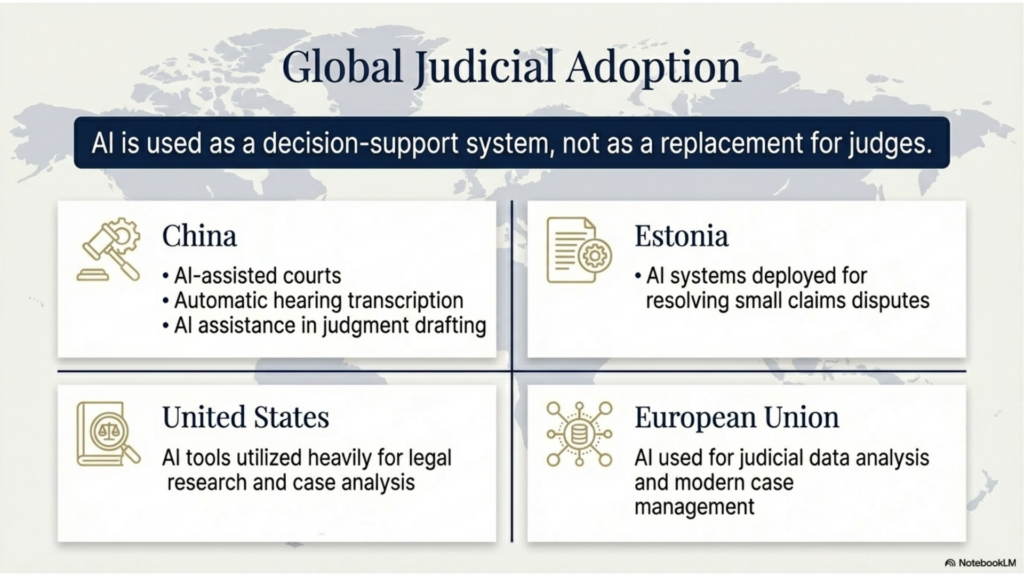
The responsible adoption of Artificial Intelligence in the legal system can bring several significant benefits. AI technologies can dramatically reduce the time required for legal research and document analysis, allowing legal professionals to focus more on substantive legal reasoning.
Efficient case management systems powered by AI can help courts process cases faster and reduce the enormous backlog of pending litigation. AI-based legal assistance tools can also help ordinary citizens understand their legal rights and navigate complex legal procedures more easily.
Digital court systems supported by AI technologies can also enhance transparency and accountability in the judicial process. Automated systems can track case progress, maintain accurate records, and reduce administrative inefficiencies.
Furthermore, the automation of routine legal tasks can significantly reduce the cost of legal services, making justice more accessible to people who might otherwise be unable to afford legal representation.
Ethical Challenges of AI in Law
Despite its enormous potential, the use of Artificial Intelligence in law also raises important ethical concerns. One major concern is the possibility of algorithmic bias. AI systems trained on historical legal data may unintentionally reproduce biases that exist in past judicial decisions.
Another challenge relates to transparency. Many advanced AI models operate as complex systems whose internal decision-making processes are difficult to interpret. This lack of transparency can raise concerns about accountability in legal decision-making.
Privacy is another important issue. Legal databases often contain sensitive personal and financial information, and the use of AI systems must be carefully regulated to ensure that such data is protected.
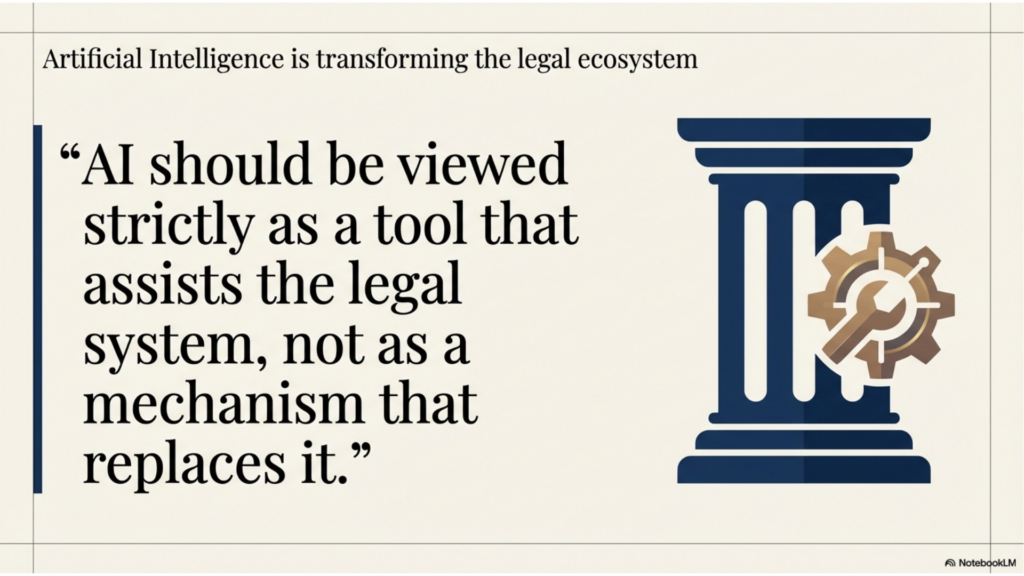
Perhaps the most important principle is that AI must never replace human judicial authority. Judicial decisions involve ethical reasoning, interpretation of legal principles, and consideration of social consequences. These responsibilities must remain firmly in human hands.
Conclusion: The Future of Justice
Artificial Intelligence has the potential to transform the justice system in profound ways. By assisting judges, lawyers, and court administrators in analyzing large volumes of legal information, AI can help make judicial systems more efficient, transparent, and accessible.
However, technology must always remain subordinate to the fundamental principles of justice. AI can assist the legal process, but it cannot replace the human wisdom, ethical judgment, and constitutional responsibility that judges bring to the administration of justice.
The future of justice will likely be shaped by a partnership between human judgment and artificial intelligence. In such a system, AI will provide speed and analytical power, while human judges will continue to provide fairness, wisdom, and moral reasoning.
If implemented thoughtfully and responsibly, Artificial Intelligence can become one of the most powerful tools for strengthening the rule of law in the modern world.
जरा हट के है आलेख। Very informative and eye opening to the legal students.
Great, its kn9wlegeble